

This is my second Substack article. The last one I wrote was over two months ago, on a weekend. I promised myself then that I would write regularly. Little did I know that the following Monday I would be confronted by news that would relegate a Substack article to the cold storage of my mind. I am still dealing with that complexity but today granted me a moment of escape and this is the outcome.
I am sticking to the theme of my in-progress book on Moving Theory by casting a different lens on this movement. I may have mentioned my interest in politics, political theory, cultural studies – and the book I am working on is to some extent about posthumanism. My first Substack piece was on ‘The not-so-subtle art of the dark enlightenment’. I am moving theory this time by drawing inspiration from a less-cyborg, more-natural side of my thinking and being.
This piece is about gardening but written by a non-gardener. I am a so-called landlord – of a tiny piece of earth that I can grow whatever I like on especially because it is not overlooked and can therefore not be an eyesore for a sensitive neighbour. I could turf it, fill it with concrete, build a tiny paddle pool, extend my home with some planning permission, grow pretty flowers, get a landscape artist to design a teensy Japanese garden – well you get the drift.
But I chose to go with a wild garden. A lot of the credit goes elsewhere – soil, seeds, sunlight, rain, bees, butterflies, air, water and earthworms. A well-informed friend gave me some tips on how to get started. I also downloaded an app to identify what I hoped would grow. I don’t spend hours weeding (I wouldn’t know how to identify one) or disciplining the various inhabitants of my garden. They do as they please most of the time.
I broadcasted the seeds around June. These are pictures I took earlier this week. Yeah – quite wild - and I have no idea what to do. For instance, to my eyes, they look great and I take pride in the birds, bees and butterflies the flowers seem to attract. I have also spotted all sorts of bugs and insects. I need another app to identify them. Maybe later, for another piece on Moving Theory. Anyway, here are some pictures.

I estimate that around 40 per cent of the garden is covered in fig-leaf goosefoot and mugwort (if this is wrong, blame the app. Reliable information is critical).
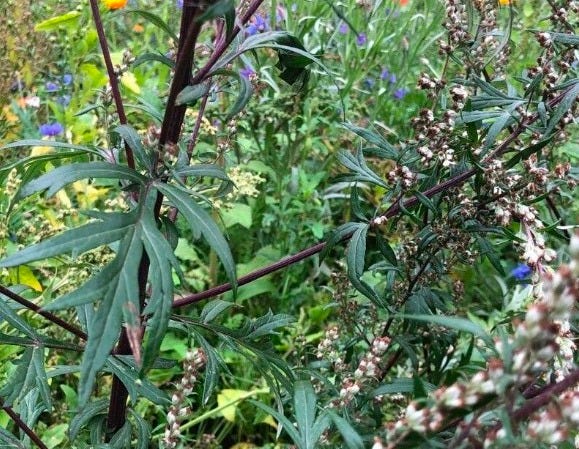
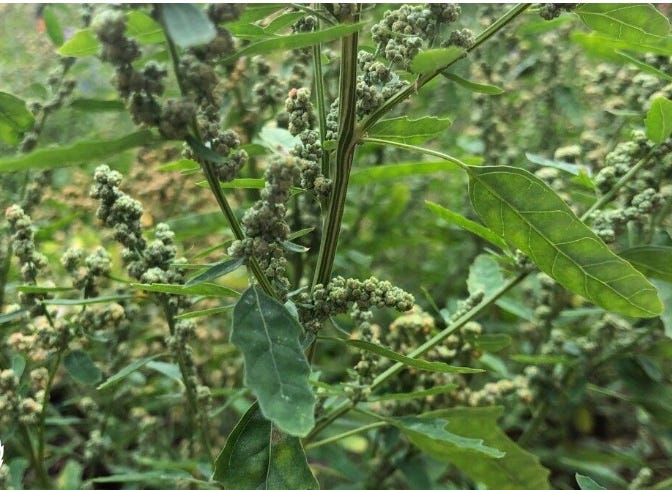
Figleaf goosefoot is occasional where I live and considered a weed in some places. Wikipedia also suggests it has Irano-Turanian origins and is quite common in parts of Europe including Poland, Czech Republic etc. I am also told it can be seen in arable land, manure heaps and waste places. Mine are growing outside of these, I can assure you. Mugwort are quite common and some species have medicinal value and used in Chinese medicine. We also have Japanese and Korean varieties and in Europe they are known to exist since the Iron Age.
I also read that foragers love them and use them to make all sorts of delicious dishes including tea, soup and pesto. Now should I let them grow wild or control how much of this is allowed in my territory?How much is too much? I am also not sure I would enjoy a cup of mugwort tea or a plate of mugwort-pesto pasta. Should I strictly go by what I think ‘deserves’ a place in my garden or have respect for what the butterflies and bees think? I have spotted some pretty butterflies that visit every day and wonder what they would feel if they came in one day found their homes and food gone. Butterflies and bees are also becoming rarer these days - dangerously so.
There are some other plants too - but less dense by the look of it. They add some beautiful colour. I wonder how they appear to birds, bees and butterflies.


My app tells me what I have here is: clockwise - cornflower, common poppy, borage, Hungarian chamomile, bitter bottle gourd, calendula, charlock and viper’s-bugloss. The poppy in the centre is not a ‘common’ poppy.
The bitter bottle gourd was planted with a lot of love and came from a pack labelled ‘courgettes’ if I remember correctly. I suspect the app has it wrong this time because if it is indeed a bitter bottle gourd, just 1.2 mg of cucurbitacins compounds could do you much harm. Question is should I get rid of it or wait for evidence to see if it is indeed a courgette? How much misinformation is coming from the app? Or maybe the garden centre did not do a good job with the labels?
The chamomile has multiple uses as a flavouring, an ingredient in cosmetics etc., although not always safe for those with particular health conditions.
The poppy has a lot of sentimental value and looks very pretty. Its habitat description is quite interesting too - I wonder where mine came from and how far they travelled to be here.
I thought the cornflower was a common plant until I read the Wikipedia page and learned also that it is an archaeophyte and introduced in the Iron Age.
The borage is one to preserve - pleases the eye and the palate, apparently. It is also believed to be a good companion plant (cooperation? collaboration?) although there are some toxic varieties.
The calendula is a medicinal herb, some species used by the Romans and Greeks in ritual ceremonies and at one point thought to be of more value for magic than medicine. Complex history, this one.
I haven’t forgotten the charlock - both a weed during plentiful times and a food during famines.
So, I have some questions:
Should I limit the spread of figleaf and mugwort to allow other plants to flourish?
Should I regulate where the ‘wild plants’ grow so I can control how the garden looks and what it does? What sort of categorisation would let me make a neat distinction between weed and welcome plant and to what extent should I question this categorisation in light of the information that I now have?
Should I gather some data on what plants are native to my garden and therefore have a better chance and right to grow and thrive here? Should I go all the way down to the Iron Age or just stick to the past two centuries?
Should I attempt to investigate whether there are plants in my garden that are fewer in number but quite dominant in the way they use up the resources in the garden and demand more water and nutrition? Maybe the data I am using is misleading and I need to dig deeper to unearth helpful facts?
Is there a point in looking at the bigger picture? Focus on what the bees and butterflies like so that there will be enough food in the world to eat - a little bit of disorder in my garden might serve a bigger purpose.
The garden certainly got me thinking about moving theory and the politics of identity and difference through these metaphors. Meanwhile, there has been news this week about ‘unsustainable’ illegal immigration, the tech prosperity deal, and a growing group of young protestors outside Google Deep Mind on hunger strike. As political parties that wish to remain relevant engage in the art of realpolitik by attempting to correctly read the room (helped or hindered by algorithms), it may well end up being a case of winning electoral mileage but not stability. For that we need a close reading of history, an engagement with questions of justice and the courage to resist and challenge the Goliaths of our time as Luke Kemp argues. That is more about politics and less about playing musical chairs with the empty seat of power. Meanwhile, I will let you know how things go with the garden.
Hi Priya! Welcome to the wonders of gardening. I've been a member in a community garden for quite awhile and we've opted to focus on growing food - partly because it's healthier and better for the environment than buying food shipped here. But it's a lot of work! Some of our fellow gardeners give their plots over to flowers and herbs that need less care. I was wondering what you meant by "wild"? Do you mean indigenous? We grew for the first time this season the indigenous Tepary beans - because they can withstand the heat and drought we have here. A lot to think about . . .