

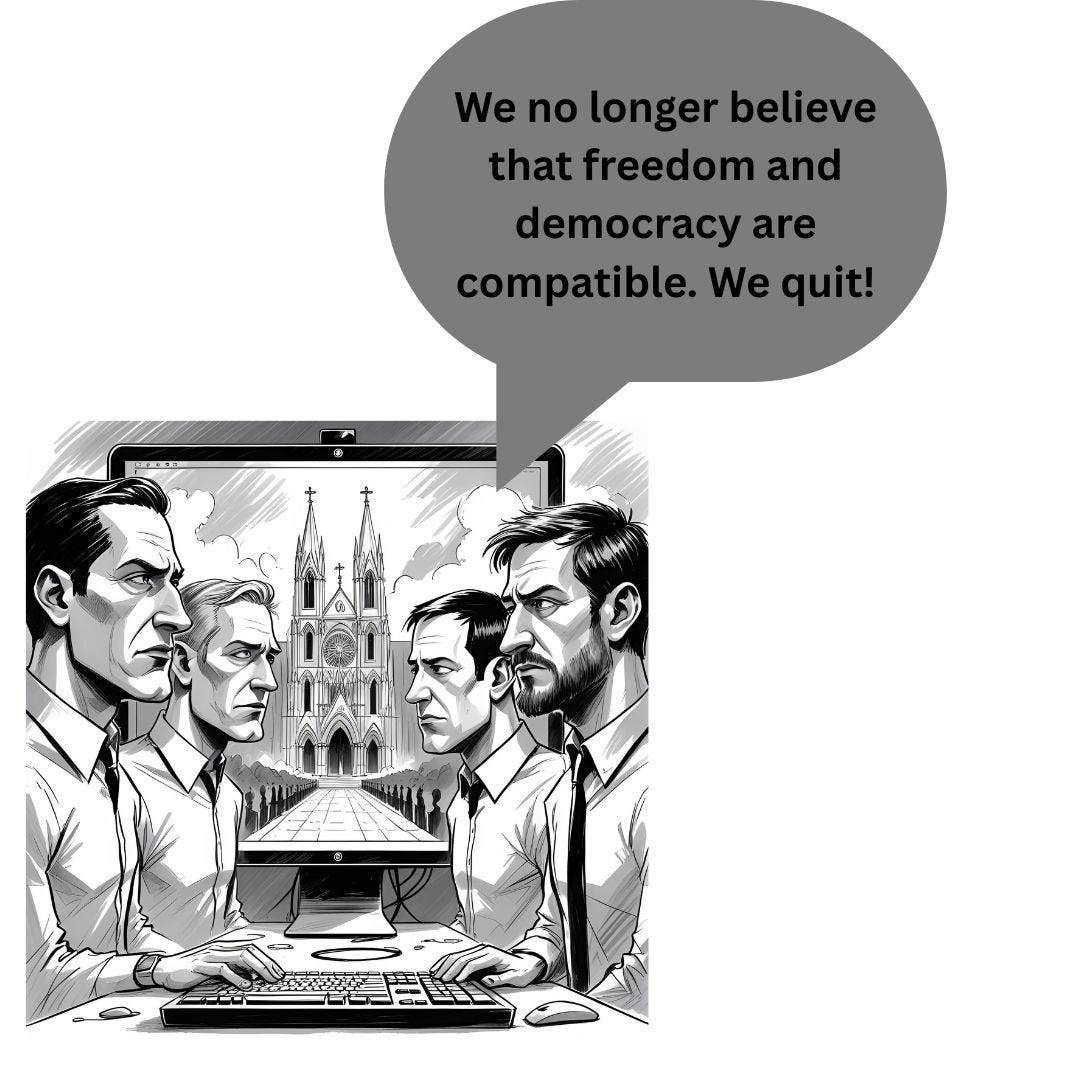
Everyone (and their dog) is on substack these days. I am finally here too, I think. This substack is about and for a book project. I realise this is a crazy time to be writing a book. The clever ones are calling what we are experiencing a 'polycrisis', popularized by the historian Adam Tooze. The WEF of 2023 was where Adam Tooze’s polycrisis got its big moment - anything man-made or not that was too complex to understand or overcome got put into the mix of what’s driving us all nuts. So, the COVID-19 pandemic, the war in Ukraine, probably add Gaza and Israel-Iran to the mix, Trump tariffs and even the fallout with Musk - you get the drift. Also, we are floating in a zone of constant and sustained shocks – a cognitive war zone – and so while you may recognise the time stamp of this piece, there is nothing to say what bigger shock could be round the corner that will pulverize the shocks that came before into obscurity. Of course, these bigger shocks too will get thrown into the polycrisis basket.
This is the kind of time when one wonders if there is a getaway, an off-the-grid existence that can be meaningful without the pain and sense of hopelessness. Meaningful yet relatable.
One version of the clever one’s solution to this problem is the dark enlightenment. To know more about this, one can read Yarvin’s biography in the New Yorker or Nick Land’s blog. The approach is straightforward and cuts to the chase. The end justifies the means – it is a ‘just do it’ approach to the polycrisis.
Put simply, enlightenment had got it all wrong. The faith and hope that human rationalism would prevail and help carve a world where reason ruled, science paved the way for enlightened living and where equality and liberty meant something was all a pipe dream.
Dark enlightenment rids us of these fanciful and vague notions of egalitarianism and freedom.
Peter Thiel and other tech barons ‘no longer believe that democracy and freedom are compatible’. Instead, they argue that we need lean and mean teams promoting operational efficiencies, optimising performance and maximising profits and growth. Those most capable, those most resourced, they argue, need to get ahead, unfettered. Well, as for the rest, they point to Darwin.
These tech-utopianists subscribe to the view that the idealisitic and false notion of egalitarianism in a world that is predicated on the survival of the fittest is a clever libertarian ploy to keep people believing, to keep the bewildered herd hoping that the power of democracy will eventually balance the scales in their favour. Dull, inept politicians, the corrupt fake news media and career bureaucrats meanwhile use the libertarian ideology for their own ends with no real progress made in terms of growth or profitability.
Post the election of Trump, this language and ideology has gained significant momentum, the need to be subtle no longer relevant or strategic. What we are witnessing is a story that has been in the making for a long time. One that most of us are only waking up to. In this narrative, the election of Trump as President for now and potential CEO and Monarch-in-waiting is part of a bigger technoauthoritarian project, one that will eventually create a world marked by exceptionalism, where the fittest and the most capable will create ‘network states’ that can, fuelled by techno-capitalist methods, accelerate our progress towards the next stage of human evolution.
If, like me, you are disturbed by the ratio of human to cyborg in this imaginary, you’d probably see that the clever ones are not so clever after all. Powerful and influential, perhaps, but still deluded and evidently the puppets of the technology that is now using the building blocks in its DNA to create more and more cyborg. A DNA written by certain types of humans - mostly elite, white, privileged, CIS-gendered male - and those that clone their thinking and doing to stay in the game. Indeed, I am inspired by the potent arguments of French Philosopher, Bernard Stiegler, most known for his work on technics. As Stiegler argues, technology is central to the formation of human subjectivity and plays a key role in human cultural formations. If one looks back at the decades since Zuckerberg built his machine that ran on human negativity, there have been disclosed, discovered and undisclosed social experiments that have shaped our lives and cultures in more ways than we realise.
An extrapolation of the idea of technogenesis (how humans shape the tools that shape us or the co evolution of humans and machines) in the context of this skewed ratio of human to cyborg (think digital platforms, AI) suggest a world where the human is increasingly written out of the cyborg DNA script as techno- and cyborg culture prevails leaving behind mere traces of human nature and culture. While all human life and non-human life will be put in the path of existential threat, the cyborg script is of course written by certain dominant categories of human.
So, should we entrust our fates in the hands of these not-so-clever ones? Or has that ship sailed already? Google’s recent bet on fusion worries me. This too is apparently a part of the dark enlightenment playbook, a decoupling from dependence on nature, (remember less nonhuman, less human and eventually mostly cyborg).
The book project I am working is also about disentanglements and re-weaving. It also originally started in a space far removed, where technics were not as metastasized and a space that prefigures the exclusionary social construct of the human. Not necessarily a past world, but a present one that recreates good times for the nonhuman, as Sylvia Wynter would refer to the category of human life I am alluding to. But the book is now inevitably drawn into this discussion of alternate worlds. How else, can I, in this techno-engineered world draw your attention to alternatives, not just mine but others, worlds that are fecund with possibilities and are not for quitters or exit-ers. I will keep writing.
.