

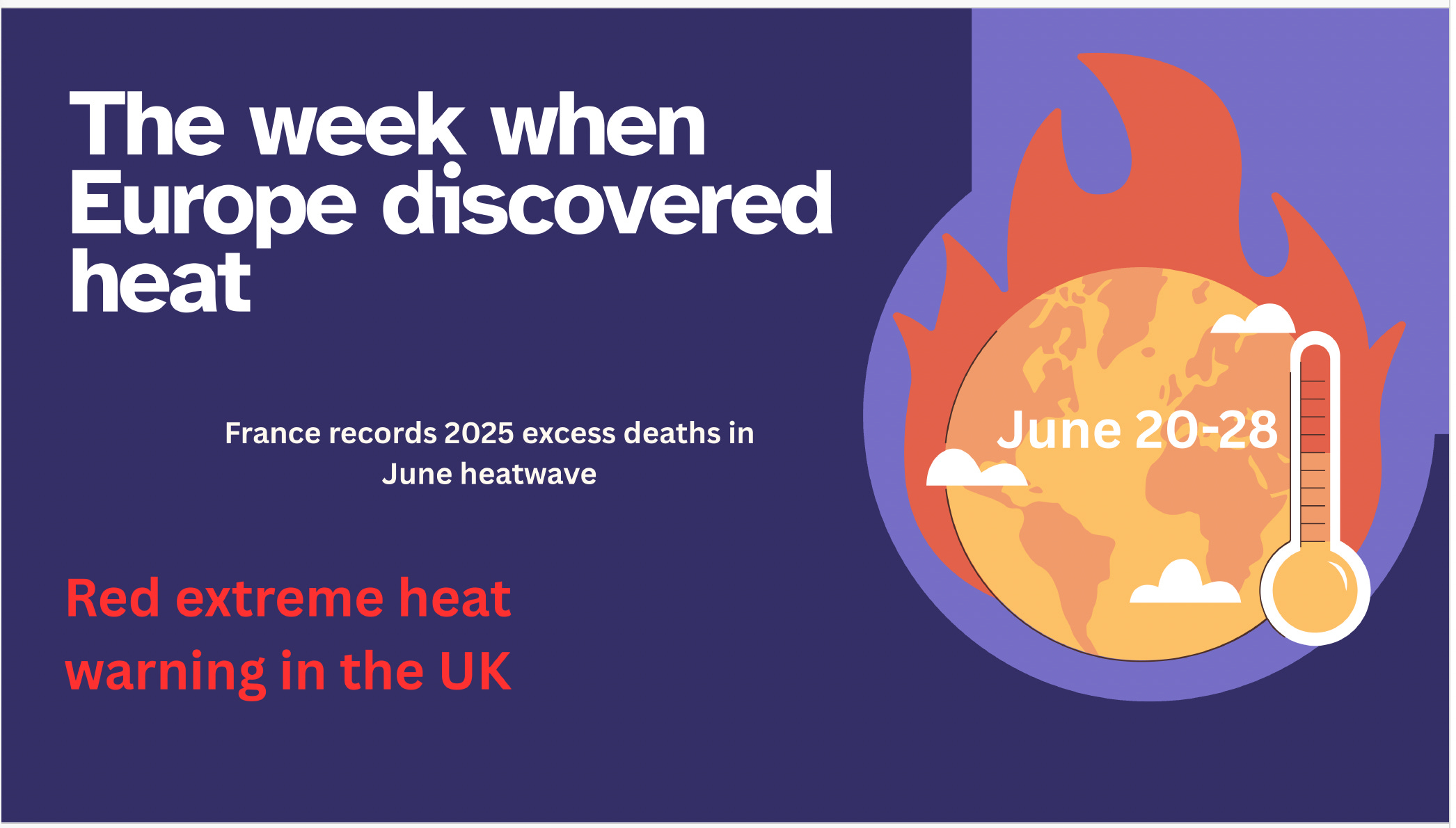
The third week of June 2026 will be remembered as the week when Europe discovered heat. That it happened during the London Climate Action Week was sheer coincidence, a lucky coincidence even. As a professional working in the ‘sustainability’ space, I follow scores of climate and sustainability leaders and not surprisingly, my LinkedIn feed overflowed with opportunistic humblebrag, sharp analysis and emotional overwhelm, all uniformly anchoring their posts to the unbearable heat. It was a good time to be talking about climate change. It was also a hyperreal moment, as Baudrillard describes a moment when the simulation seems more real than reality - when the reality of a planet that has been warming for decades seemed less real than this digitally mediated discovery of the fact, thanks to an opportune heatwave.
For 20-year-old Shahida who lives under a Delhi flyover, however, heat is the concrete floor she lives on, the air she breathes, and the worry that is embedded in her brain as she wonders whether her toddler will survive the summer. But Shahida won’t be at any climate action week anywhere and won’t be posting on LinkedIn either. Nor will the millions of garment factory labourers, farmers, or construction workers around the world who have for long been suffering the physical and psychological impact of this human-induced calamity but have no soap box to sermonise from. The ninth Lancet Countdown on Health and Climate change report led by a UCL research team reveals that, globally, a life a minute is lost due to climate change induced excessive heat. In the heatwave of June 2026, Europe, which has historically seen significantly fewer deaths due to extreme heat suffered the tragic loss of over 2025 lives.
This essay isn’t about the importance of including marginalised voices. The IPCC, the UN secretary general, and many senior world leaders have made that point quite eloquently and several times over. It isn’t about ethics or the moral imperative of climate change action either. It is about the necropolitics of climate change that determines who can live and who will die, and why the sustainability discourse, which finds itself at the crossroads, is being called upon to vote for or against this crucial question.
As a white-collar professional who has lived in Europe for over two decades, escaping harsh summers is a privilege that came with my passport - until this year, when my trip to India in the peak of the summer brought me closer to the reality of climate change than I had physically been in a long time. I was in Chennai working remotely, part of a Cambridge-based team delivering an online programme for a group of senior business leaders. The air-conditioning in my home office stopped working for a few hours. For a while, I carried on, doing my utmost to ignore the sense of suffocation and breathlessness I was feeling. I feared I might faint on camera. My feet were uncomfortably warm, hot even. I felt flat and dazed, zoned out. But through all this, my Teams persona was a professional poker face. During the coffee break, desperate for a quick solution, I headed into the bathroom, filled a bucket with water and kept my feet submerged in it for the rest of the three-hour session. My laptop told me the temperature was 38°c feeling like 45°c. The conversations around balancing short term business priorities with climate change challenges felt disengaged and uselessly distant from the urgency I was feeling in that room. As a simulation, it felt as though I inhabited a different future version of a burning planet to the one which could afford a relaxed discussion about climate change.
But the climate action world has seen further setbacks in the past few years. Since Trump happened, the western world has resigned itself to chaos, and the dominant narrative is of an uncertain, unpredictable world where a social media post can set off a war and a narrow strip of sea can hold global supply chains to ransom. Leaders of all statures, including Presidents, Prime Ministers and multinational CEOs have shaped their leadership strategy around this framing. The scramble this year is to stay afloat in the short term faced with geoeconomic confrontation, misinformation and disinformation, societal polarisation and extreme weather events, in that order, although climate change retains its top position in the long term, when it comes.
For me and many others working in the sustainability space, the change in priorities came swiftly, disproportionate to the decades it had taken for governments and businesses to get behind the Paris agreement and the Sustainable Development Goals.
The green economy and sustainability industry is a trillion-dollar industry. It covers a plethora of sectors and creates jobs in technology, construction, academia, non-profits, consulting, reporting, certifying and communications, to name a few. The moral momentum that spawned this industry and inspired disruptive innovation is now heavily reliant on capital commitment and government incentives, both of which are steered and shaped by politics and geoeconomics, and a combination of these.
What started off as a crusade for ‘our common futures’ was turned in some quarters into a growth strategy that over time became embroiled in the very playbook that had caused the problems in the first place, and this story, well known in climate action spaces, is an important sub-plot that reveals the foundational flaws in the design highlighting the importance of history in such analysis.
In the early 1970s, when conversations around human-induced climate change did not feature prominently in political circles, the publication of now widely read books such as Rachel Carson’s Silent Spring, and Limits to Growth by Donella Meadows did generate interest. But the crucial intervention of the United Nations Conference on the Human Environment initiated by Sweden was a turning point and in some ways a lost opportunity. Indira Gandhi, the former Prime Minister of India, delivered a widely quoted address highlighting the inextricable link between poverty and environmental damage. The words she spoke to call out western hypocrisy in denying development for the global south, particularly its poorest who cleared forests to keep body and soul alive, was manipulated to deflect from the excessive consumption of the west and instead frame solutions to address climate change around green growth and development. While this in itself was not a bad idea, the template that informed the solutions to drive growth and development was to a great degree influenced by commercialism and to many this was an avenue for profit-making. The political call for justice was subsumed into a weaker discussion on a moral imperative towards a more sustainable world and the role of governments and businesses in delivering it. The moral imperative meant the switch could be turned off when other priorities took hold. And this is where we find ourselves now.
As decisions are being made on what’s next for the sustainability world, what should really motivate those who were privileged enough to find themselves at the London Climate Action Week is a determination to centre justice and appreciate the relational politics that is needed to prevent the spread of heat-induced deaths currently predominant in the world’s poorest countries from visiting the west with the same intensity. Here too, it will be the poorest and the voiceless that will suffer the most. This is a moment to recognise that the politics of sustainability is in the hands of commerce. While purpose can motivate the right decisions, when weighed down by pure commercial motivation, it is forced to overlook the politics of climate justice and take slow, disproportionate steps that do not address the real problems facing society and businesses that operate within it.
There is no denying that commerce is and will continue to be hit by climate change challenges. But this is a rare moment when sustainability has gone mainstream and surfaces as risk, as an urgent need for resilience, and as a strategic priority to keep businesses viable in the long term. This is also a time to take strategic action learning from and including the needs of those who are closest to the impending catastrophe.
Climate change action is a political issue and the science that evidences the growing risks is fact, not opinion. The suffering of those most exposed is a barometer of how bad things are and it won’t just be supply chains that will be affected if critical climate tipping points are breached. Addressing inequality keeps humanity and the social fabric that we are part of, safe. We need to alleviate the suffering of Shahida who lives under the flyover in Delhi for our own sakes because it is only through understanding the inextricability of our relationship and interdependence on each other, including nature, that we can save ourselves.